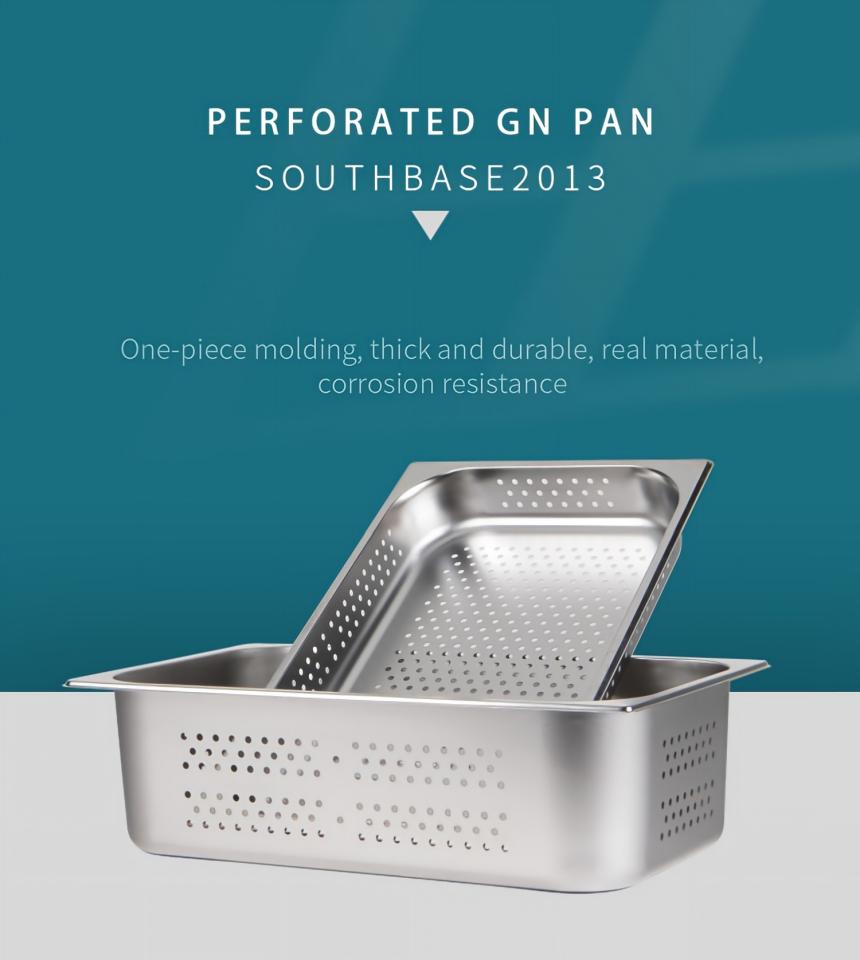
The category rewards diligence
GN pans are a commodity in appearance and a technical product in fact. The quotation sheet for a 40-foot container looks nearly identical from six suppliers, and the differences that matter — grade, gauge, rim construction, weld finish, passivation — sit in places a photograph cannot show. The purpose of a sourcing process is to move those differences into writing before money changes hands.
Seven points to help you find the best gn pan manufacturer
1. Define the product in a specification, not in a description
“GN 1/1 × 65 mm, 304 stainless, good quality” is a request, not a specification. A workable one reads:
| Gastronorm 1/1 pan, 530 × 325 mm top outside, 65 mm depth, AISI 304 per ASTM A240, 0.7 mm nominal thickness with minimum 0.65 mm after forming, seamless deep drawn, wire-reinforced rolled rim, electropolished and passivated to Ra ≤ 0.4 µm, no heat tint at welds, tolerance ±1.5 mm, food-contact compliant, packed 12 pcs per carton. |
Every clause in that sentence is testable. That is the point.
2. Ask for documents before samples
A manufacturer with a functioning quality system can supply, on request:
- Mill test certificatesfor the steel, by heat number, showing chemical composition.
- Food-contact compliance: FDA 21 CFR 175.300 for the United States, EU 1935/2004 plus Regulation 10/2011 for Europe, LFGB for Germany, and GB 4806.9 for the domestic Chinese market.
- A process descriptionof the finishing line, including whether polishing and passivation are in-house or subcontracted.
- Existing test reports— salt spray hours, heavy metal migration, dishwasher cycle testing.
A supplier who cannot produce these is not necessarily dishonest; they may simply be a trading company. That is useful to know too, because it changes who is accountable when something goes wrong.
3. Evaluate the sample properly
Samples are usually hand-picked. Treat the sample as a specification reference, not as evidence of production quality, and check it against the following:
| Check | Method | Acceptable result |
| Dimensions | Caliper at rim, across both axes, several pans | Within ±1.5 mm of nominal |
| Thickness | Micrometer at base, wall mid-height, corner gusset | ≥ 0.65 mm; corner ≥ 92 % of nominal |
| Grade | Spectrometer or MTC cross-check | Matches declared grade |
| Rim | Visual + manual flex | Closed roll, no exposed wire, resists twist |
| Corner / weld | Fingertip and bright light | Flush, no ridge, no straw/blue tint |
| Surface | Water-break test, Ra gauge | Continuous film; Ra ≤ 0.4 µm |
| Flatness | Granite plate | No rocking; ≤ 1.5 mm across diagonal |
| Weight | Scale | Consistent within lot (±3 %) |
4. Audit the factory, in person or by video
A factory visit answers in twenty minutes what a hundred emails cannot. What to look at, in order of information value:
- The press line— tonnage relative to the largest pan made, tooling condition, whether blanks are deburred.
- The welding and grinding area— is there a passivation step after grinding, or does the pan go straight to packing?
- The electrolytic workshop— bath chemistry control, current density records, rinse stages, effluent treatment. If it does not exist, “electropolished” is a claim about a subcontractor, not about the factory.
- In-process inspection stations— inspection at the press is what separates a controlled process from an end-of-line sort.
- Warehouse and packing— carton quality, polybag protection, pallet pattern, container loading plan.
If travel is not possible, a live video walkthrough with the line running is a reasonable substitute — and asking for it is itself a useful signal.
5. Agree the commercial terms that protect the specification
- Pre-production sample approval, signed and retained by both parties.
- AQL samplingfor inspection — AQL 2.5 for major defects, 4.0 for minor, is a common commercial standard.
- Third-party inspection(SGS, BV, TÜV) at the supplier’s cost, or shared, for the first order.
- Grade substitution clausewith a defined remedy, since this is the highest-risk failure mode in the category.
- Packaging specificationwith drop-test expectations, particularly for e-commerce channels where the carton is the delivery package.
- Spare and replacement ratio— 1–2 % of order value allocated to replacements is normal for a first shipment.
6. Understand lead time honestly
A deep-drawn, electropolished pan has a longer process route than a stamped one: drawing, annealing, polishing, electrolysis, inspection, packing. A realistic production lead time for a mixed container is four to six weeks after sample approval, plus transit. Quotations promising two weeks usually indicate either stock goods of unspecified grade or a process step being skipped.
7. Build a relationship, not a transaction
The commercial logic of this category is repeat business: a distributor reorders the same SKUs for years, and a hotel group re-supplies as properties refurbish. That makes consistency worth more than the last two percent of price.
A manufacturer who holds tolerances, supplies certificates without being asked and lets you walk the line is worth a slightly higher unit price — because the cost of a bad container is measured in returns, reputation and lost listings, not in freight.
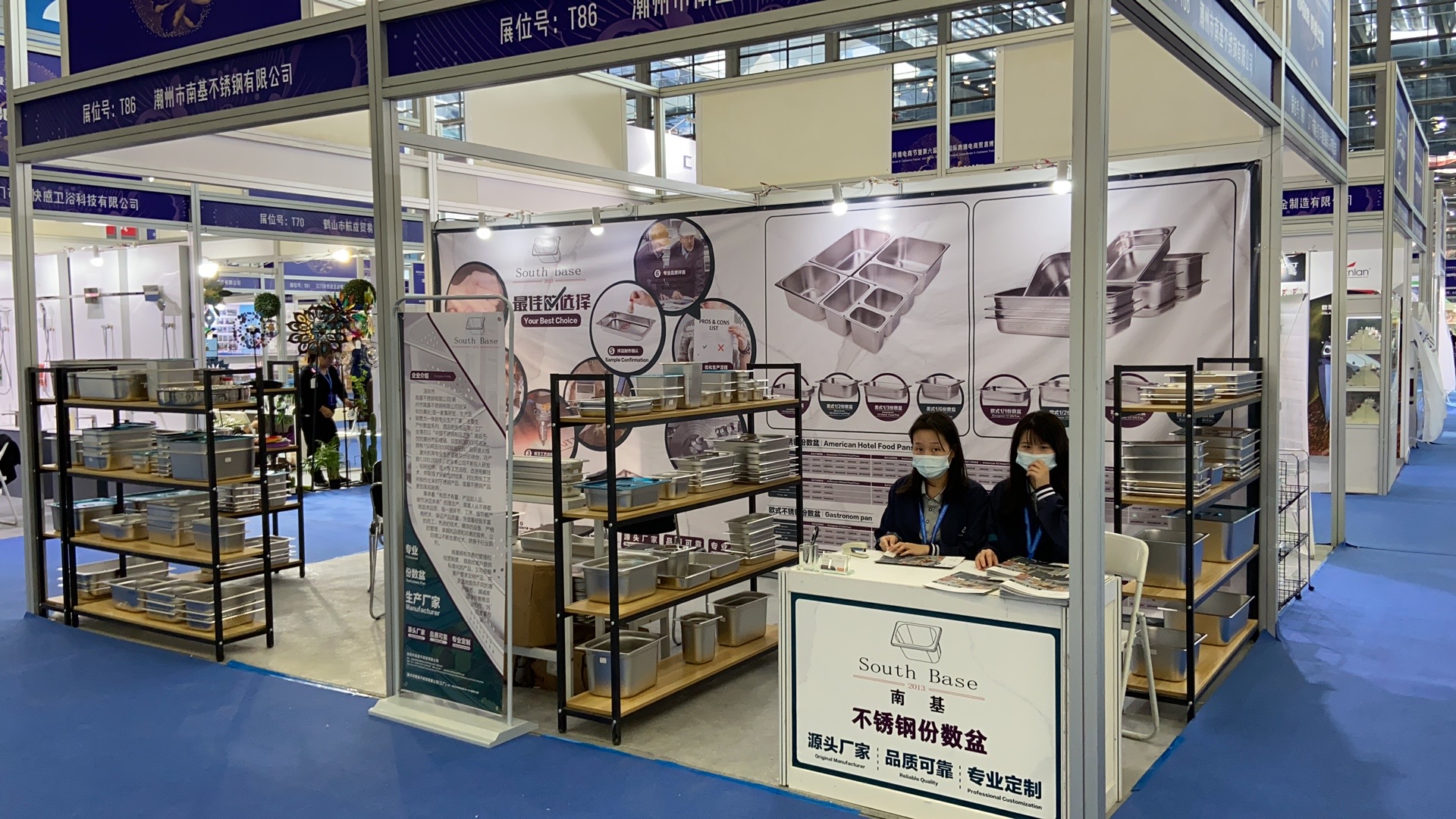
About the manufacturer. Chaozhou Nanji Stainless Steel Co., Ltd is a manufacturer of stainless steel GN pans and related accessories, producing to specification across grades 201, 304 and 316 and thicknesses from 0.5 mm to 1.0 mm. Its own electrolytic workshop handles polishing and passivation in-house, quality is guaranteed batch after batch, and the company welcomes buyers to visit the factory in Chaozhou and to request a quotation for OEM or container-volume orders.
Find Us Here
NSF certified GN Pan Factory
Email: sales@njsus.com