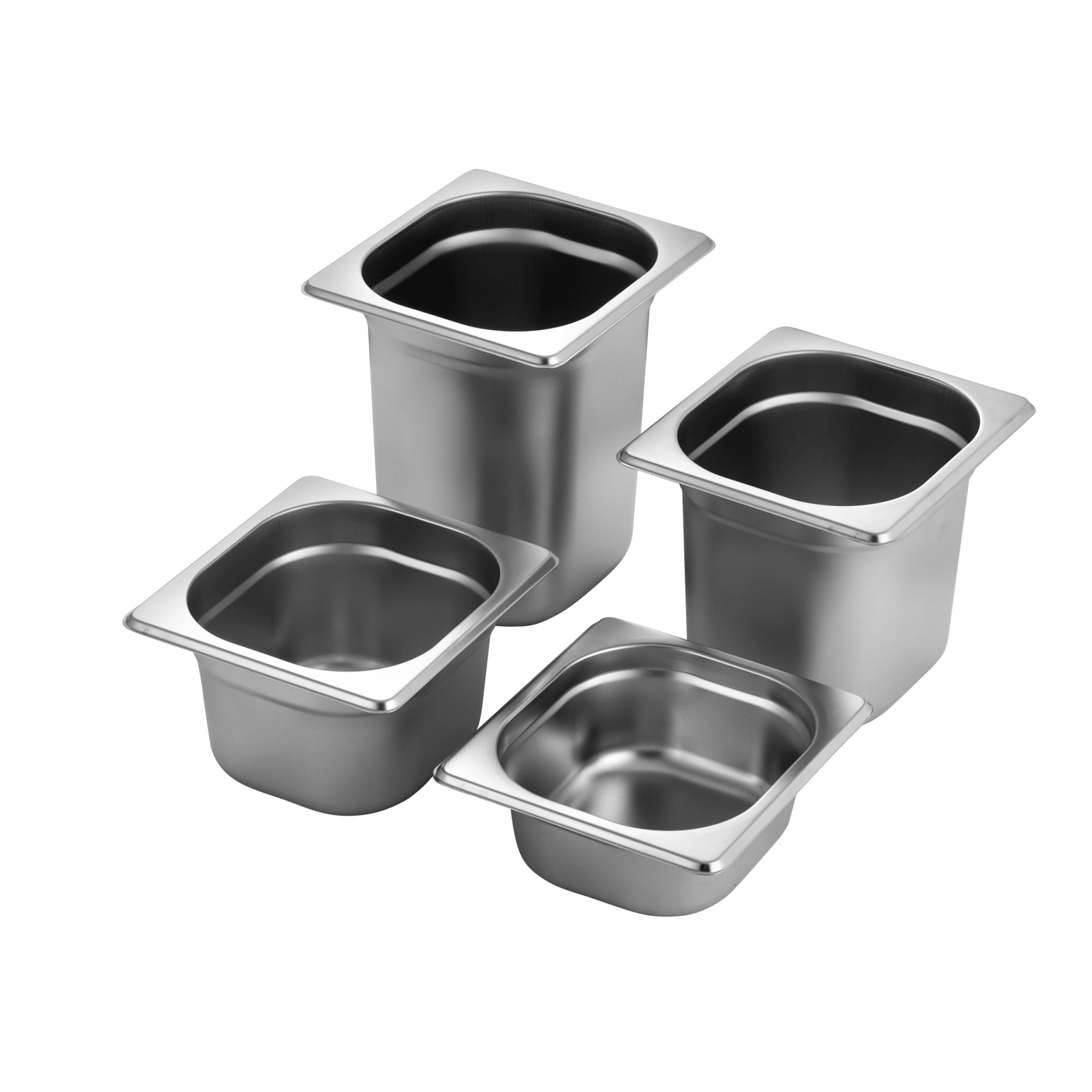
Why two pans of the same size feel so different
BPut a cheap GN 1/1 pan and a good one side by side on a bench. Same footprint, same height, similar shine. Pick each up by opposite corners and press gently. The cheap one flexes, and the rim twists out of plane; the good one resists. That difference is not marketing — it comes from three measurable design decisions: material thickness, rim construction and corner geometry.
Thickness: what the numbers mean in practice
Thickness is quoted in millimetres, and the range for GN pans is broad:
| Thickness | Weight, GN 1/1 × 65 mm (approx.) | Behaviour |
| 0.5 mm | 0.55 kg | Light duty only; deforms under a full load |
| 0.6 mm | 0.68 kg | Economy standard; acceptable for buffet display |
| 0.7 mm | 0.79 kg | Good commercial balance; the usual export grade |
| 0.8 mm | 0.90 kg | Heavy duty; holds shape through thermal cycling |
| 1.0 mm | 1.13 kg | Industrial; banqueting, bulk transport, long life |
Two things are worth knowing. First, “gauge” is a confusing unit and should be avoided in purchase orders — the same gauge number means different thicknesses in different gauge systems. Specify millimetres.
Second, and more importantly, thickness is not uniform after drawing. The base stays close to nominal, the walls thin slightly, and the corner gussets thin most. A pan specified at 0.7 mm may measure 0.62 mm at the corner. If a supplier quotes only one number, ask where it was measured.
trusted expertise
Self-Developed Annealing Furnace
Thickness
0.55/0.6/0.7/0.8mm
The heat-warp problem
A GN pan used in a combi oven or under a salamander goes through repeated heating to 180–220 °C and cooling to chilled or ambient. Thin material warps because the rim and the base expand at different rates and the pan has too little stiffness to resist the resulting moment. Once the base is no longer flat, the pan rocks in the steam table well, hot spots form, and holding temperature becomes uneven.
The classic symptom is a pan that “clicks” when you press one corner. It is not repairable and it is entirely predictable from the specified thickness and rim design.
Rim construction: the stiffening member
The rim is the pan’s structural ring beam. Three constructions dominate:
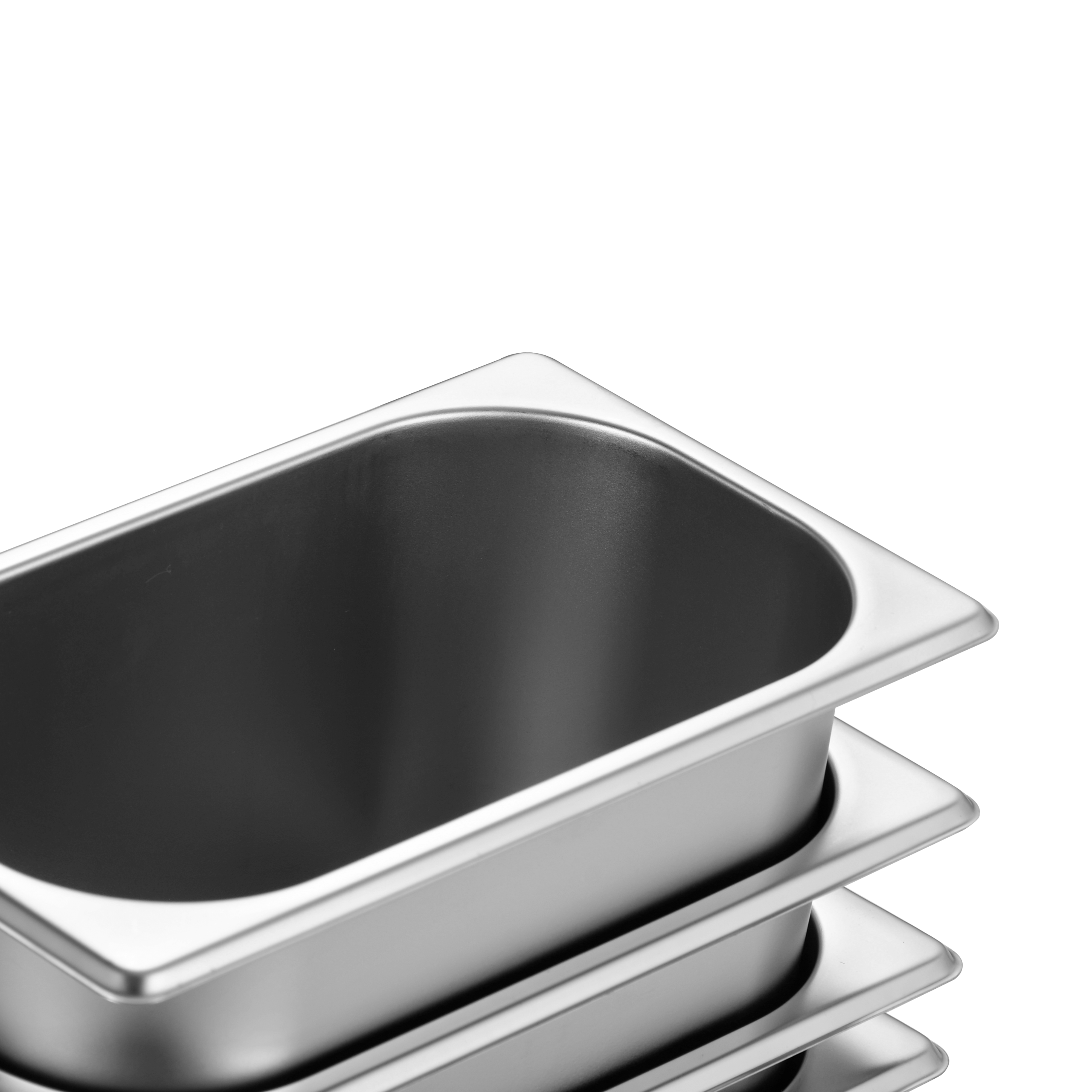
- Rolled rim (single curl).The edge folds over once. Cheap, safe to handle, adequate for display pans.
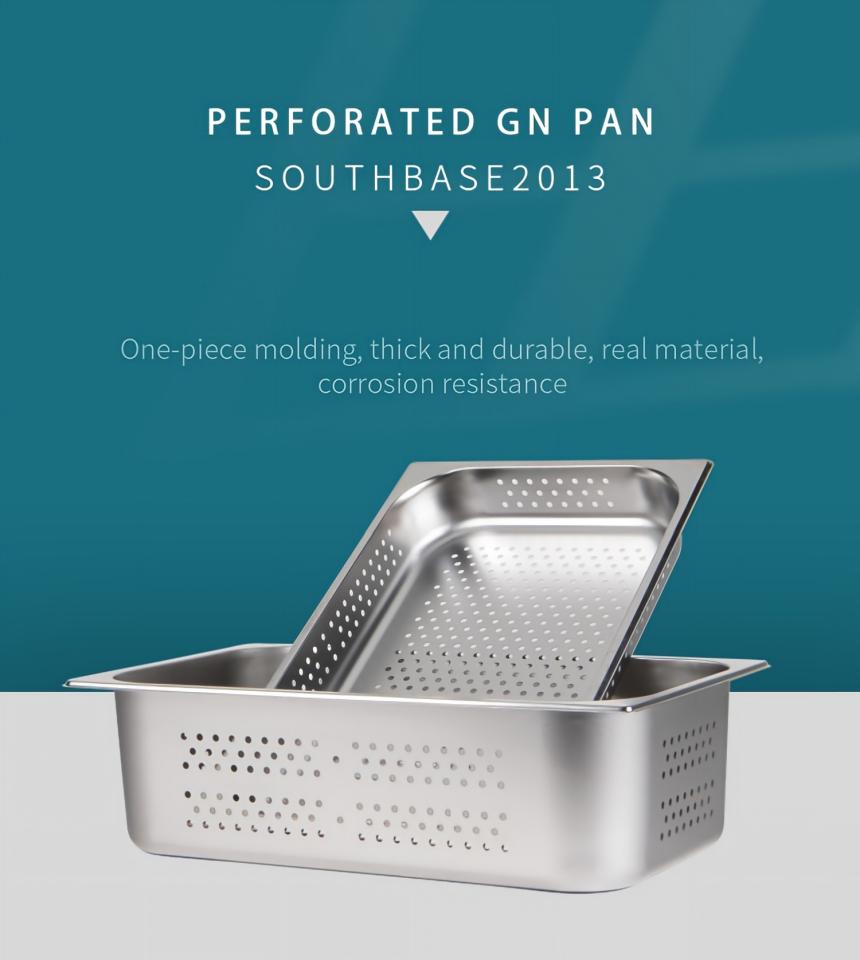
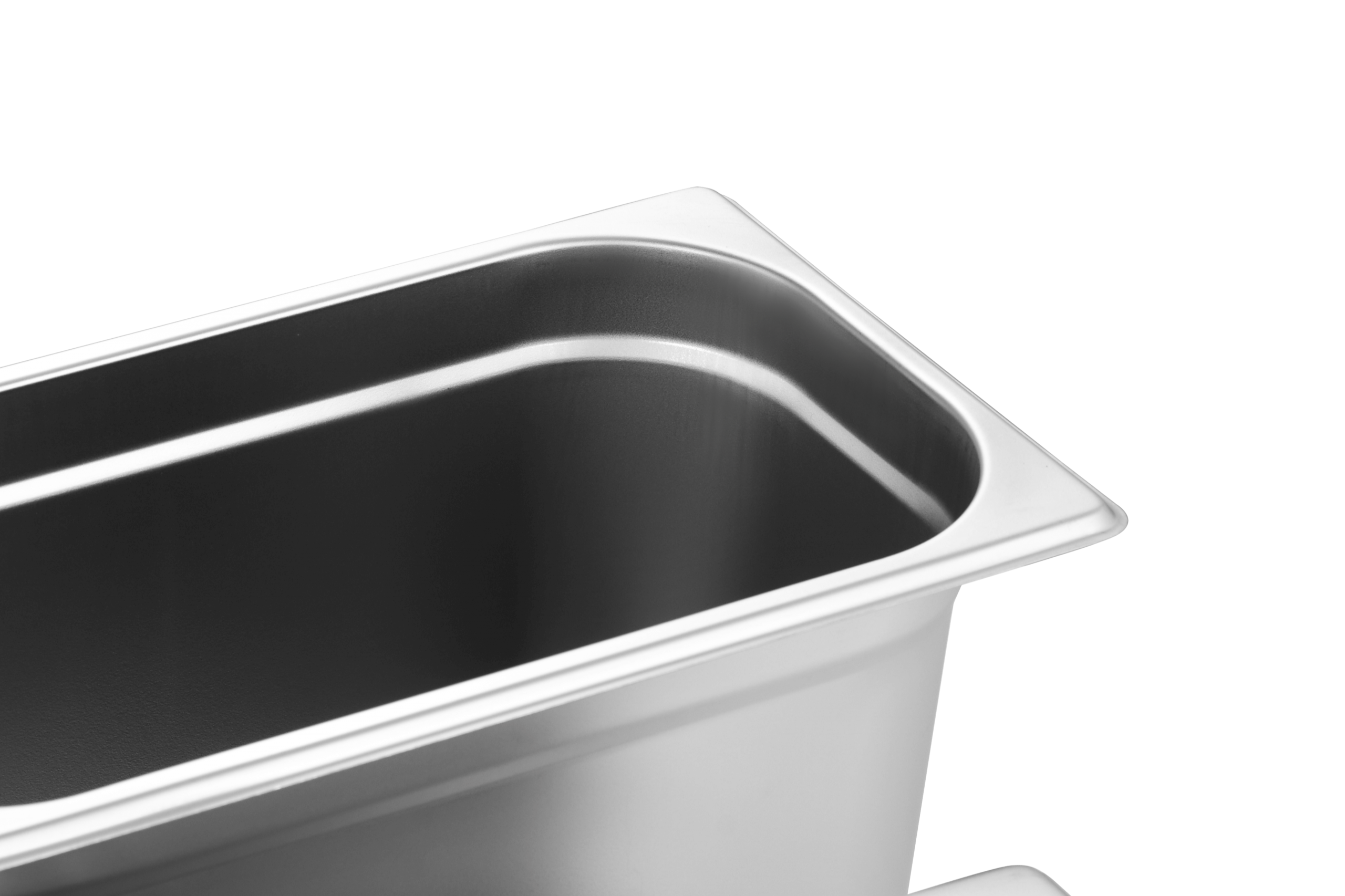
- Wire-reinforced rim.A stainless wire is enclosed inside the curl. Stiffness increases substantially for a small material cost, and the rim resists ovalisation when a full pan is carried one-handed. This is the detail that separates professional-grade pans from catering disposables.
- Flat flange.No curl, just an outward fold. It is the weakest option and also the one that catches on well edges.
Rim width matters too. The rim has to seat on the well ledge and be wide enough that the pan does not drop through when loaded. A narrow rim concentrates load and dents.
Corner geometry: hygiene and strength together
The corner is where the drawing process works hardest and where the pan either earns its price or reveals it.
- Large radius cornersdraw easily and are strong, but they reduce usable volume and make it harder to scrape out the last portion — a real cost in portion-controlled kitchens.
- Tight radius cornerslook sharp and hold volume, but require better tooling and more careful draw control, or they thin and crack.
- Welded cornersmust be ground, polished and passivated. A visible weld line, a heat-tint zone or a step at the joint is a hygiene defect, not a cosmetic one: food lodges there, and the chromium-depleted weld zone corrodes first.
A useful test on a sample: run a fingertip along the inside corner weld. It should feel continuous with the wall, with no ridge, no roughness and no discolouration. Then look at the outside of the same corner under a bright light — any straw or blue tint means the part was not properly passivated after welding.
Specification language that gets results
| Property | Weak specification | Effective specification |
| Thickness | “0.7 mm” | “0.7 mm nominal, minimum 0.65 mm at any point after forming” |
| Rim | “rolled edge” | “wire-reinforced rolled rim, fully closed, no exposed wire ends” |
| Corner | “seamless” | “seamless deep drawn; where welded, ground flush, polished and passivated, no heat tint” |
| Flatness | — | “base flatness within 1.5 mm across the diagonal; no rocking on a granite surface plate” |
| Grade | “stainless steel” | “AISI 304 per ASTM A240, mill certificate required per lot” |
The economics of getting it right
A 0.6 mm pan costs less per unit and more per year of service. In a hotel that runs three meal periods, pans are washed several times daily and stacked in trolleys; the first deformation usually appears in the rim, then the base, then the weld. Replacing a set every eighteen months costs far more than the initial difference between 0.6 mm and 0.8 mm — and it costs in service quality too, because a warped pan does not hold temperature evenly.
| About the manufacturer. Chaozhou Nanji Stainless Steel Co., Ltd manufactures stainless steel GN pans and related accessories in thicknesses from 0.5 mm to 1.0 mm, with wire-reinforced rims, seamless deep-drawn bodies and fully passivated welds where welding is used. The company operates its own electrolytic workshop, guarantees consistent quality across batches, and invites buyers to visit the factory to inspect gauge, rim and corner finish first-hand before requesting a quotation. |
Find Us Here
NSF certified GN Pan Factory
Email: sales@njsus.com